
Pennies for Public Transit is a citizen-led, grassroots advocacy campaign to secure stop-gap funding that will keep Vermont's public transit systems running for the next two to three years while the Legislature works toward a permanent solution. We're asking for pennies, literally about three cents on a gallon of gas, to prevent service cuts that would set our communities back for years.
Here's what's happening, why it matters, and how you can help.
tl;dr
- Transit in Vermont is on the brink of collapse, and every legislative study says the long-term solution is a dedicated funding stream for public transit
- Governor Scott has made clear that he will veto any new taxes or fees this year, so we’re rallying around a proposal that expands the local options tax so municipalities can “opt-in” to a gas and diesel tax to raise money for transit
- We’re on a tight timeline—just a matter of weeks—and we need you to write to your legislators to push them on the necessity to act on this short-term transit funding solution
Public Transit Is for Everyone
There's a stubborn myth that public transit is a last resort, something only for people who have no other choice. But transit is foundational infrastructure that benefits entire communities, whether you personally ride the bus or not.
Transit gives independence to the ⅓ of Americans who can't or otherwise don’t drive: kids getting to after-school jobs, older Vermonters aging in place, and people with disabilities who deserve the same freedom of movement as everyone else. For many working families, transit is the most affordable way to get around. The socialized cost of a public transportation system is dramatically cheaper than every household needing to own, insure, fuel, and maintain a car, and incurs less maintenance cost on our roads per-person. Even though many working people rely on cars for daily transportation, this is largely a consequence of long term failure to provide more affordable public options.
When transit service gets cut, the riders who depended on it don't wait around for it to come back. They rearrange their lives around the absence of the service they lost, often at enormous personal cost.
The benefits extend well beyond individual riders, too. Functional transit is what makes denser, more affordable housing possible. Without it, every new home needs to come bundled with parking spaces and road capacity, driving up costs and eating up valuable downtown land. Good transit frees up that space for homes, businesses, and the kind of vibrant places that make Vermont towns worth living in today and in the future, given that transportation is Vermont’s single largest sector for carbon emissions.
Perhaps most importantly, transit is a compounding system. When service is good, more people ride, which brings in more funding, which makes service better. But the reverse is also true, and that's exactly the danger we're facing right now.
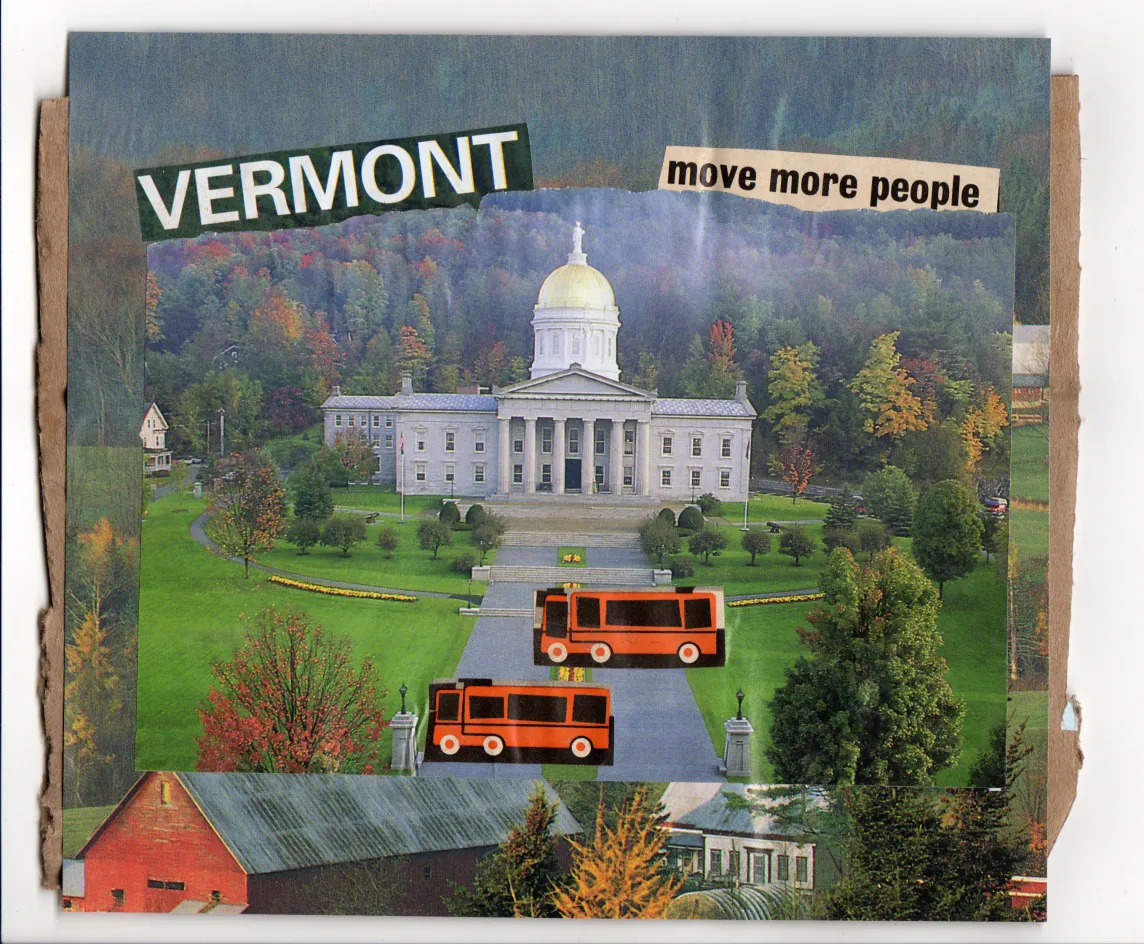
Vermont, Move More People by VPOP members Nick and Anna (Feb 2026)
What's at Stake
Vermont does not have a dedicated funding source for its seven public transit systems. State funding varies year to year and is always vulnerable to cuts when the transportation budget gets tight. Every study the Legislature has commissioned on this topic has reached the same conclusion: the best path forward is a dedicated statewide funding stream reserved for public transit.
Unfortunately, Governor Scott has made clear that he will not support any new statewide taxes or fees, effectively blocking all of the recommended permanent solutions. That leaves our transit providers heading into the next few years with no safety net and major budget shortfalls on the horizon.
As a notable example, Green Mountain Transit (GMT) is the state's largest public transit provider, running fixed-route bus service across eight Chittenden County communities with a combined population of over 130,000, plus paratransit and inter-city commuter routes serving an even broader region. State funding as a share of GMT's revenue has been in steady decline, from 26% in 2012 to just 12% today. GMT has already had to cut service in recent years to stay afloat.
Now it faces its largest budget gap yet: a $3 million shortfall starting in mid-2027 that could force the elimination of up to a quarter of its fixed-route service.
If we let our transit systems deteriorate now, we are setting ourselves up for a painful transportation bottleneck just as more housing comes online.
Cuts of that magnitude trigger what transit experts call a "death spiral." Less service leads to fewer riders, which leads to less federal funding (since much of it is awarded based on ridership), which leads to even less service. The cycle feeds on itself.
And here's what makes this so urgent: when transit service gets cut, the riders who depended on it don't wait around for it to come back. They adapt. They change jobs. They move. They scrape together the money for a car. They rearrange their lives around the absence of the service they lost, often at enormous personal cost. And if service is eventually restored, those riders are already gone. They've built new routines and new commutes. They're not coming back. In other words, losing ridership is essentially a one-way door. It takes years to build a transit ridership base, but service cuts can drain it quickly.
This couldn't come at a worse time. Vermont is in the middle of a serious push to grow its housing stock, and that growth requires functional public transit to work. Chittenden County has been tapped for tens of thousands of new homes between now and 2050. If we let our transit systems deteriorate now, we are setting ourselves up for a painful transportation bottleneck just as more housing comes online. More people, more homes, and no viable way to move around without a car.
Fortunately, there's a bill in the Legislature right now that can help.
The Plan: House Bill H.766
Representatives Mollie Burke (Brattleboro), Kate Lalley (Shelburne), and Chloe Tomlinson (Winooski) recently introduced H.766, a bill that would give municipalities a new tool to fund public transit locally.
Under current state law, cities and towns can assess a "Local Option Tax" (LOT) of up to 1% on three categories: rooms, meals & alcohol, and sales. H.766 would add a fourth category, gas and diesel fuel, allowing a 1-cent local options tax on each. The bill doesn't impose this tax itself. It simply authorizes municipalities to do so and to decide locally how to spend the revenue, in this case ideally directing it to transit as the bill's authors envision.
VPOP supports this bill, and we also want to see it go a step further: instead of a 1 cent option tax on gas and diesel, we’d like to see it be a 1 percent option tax, the same as the existing cap on sales, meals, and rooms. In practice, if Chittenden County communities adopted this 1% local options tax, it could add roughly 3 cents per gallon at the pump and channel that money directly into local public transit.
H.766 is not the permanent dedicated funding source that study after study has recommended. It will generate a modest amount of revenue that will naturally decrease over time as electric vehicles become more common. But that's okay. This isn't meant to be the long-term answer. H.766 is a bridge: a way to quickly raise meaningful money for transit providers and buy time until a permanent solution can be established.
How You Can Help — Right Now
The most important thing you can do today is contact your state Senator about H.766 before February 22nd. The bill will be moving from the House to the Senate soon, and we need Senate leadership to understand what's at stake before it lands on their desk. Even a few sentences makes a difference. Legislators pay attention to constituent voices, and every message counts.
Here's how to get involved:
- Send an email or letter to your state Senator urging them to support H.766. To do this, first find your legislators, and then use this Form Letter that we've prepared as a starting point to draft your letter—make sure you update the names, and fill in your own personal transit story in the middle!
- Join us at the VPOP Social Hour on February 17th at Specs in Winooski, where Rep. Chloe Tomlinson will be joining us to talk about H.766 and what comes next for the Pennies for Public Transit campaign.